
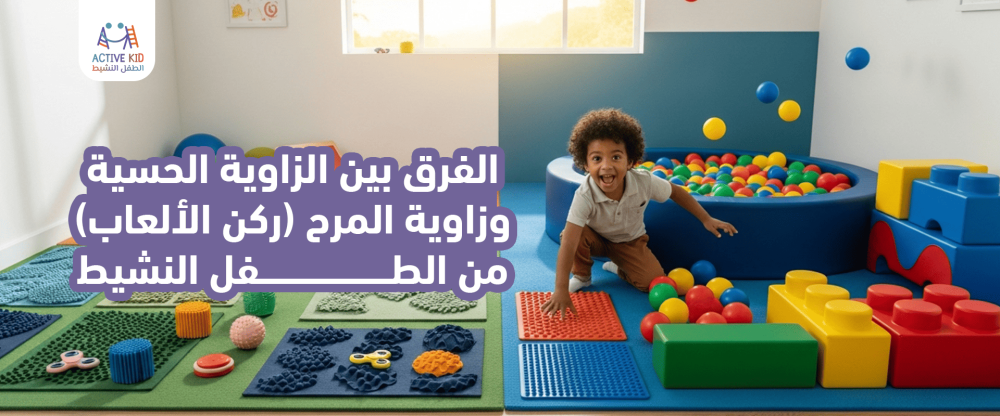
In a child's world, the physical environment is fundamental to their learning and motor experience. Parents and teachers face the challenge of designing specialized spaces that meet diverse developmental needs, from the need to release energy to the development of fine motor skills. Distinguishing between a play area (or fun corner) and a sensory corner is crucial, as each serves a very different purpose in a child's development, especially for active children who require a balance between physical stimulation and sensory stimulation.
This comprehensive guide aims to deconstruct these two concepts, explaining the fundamental differences between them in purpose, design, and developmental contribution, to help you create an integrated environment that supports your child's motor and sensory development.
With the Active Child Fun Corner , your child gets a safe and fun space to release their energy, create, move and learn, so that every moment of play becomes an opportunity for growth and development.
What is the sensory angle? And how does it contribute to the development of a child's senses and basic skills?
A sensory corner is a carefully designed, dedicated space that provides specific sensory inputs and outputs. Its purpose extends beyond mere entertainment to meet the child's neurological and educational needs. A sensory corner is a structured and controlled environment that aims to:
- Nervous system regulation: For children who are hypersensitive or hyposensitive to certain inputs (light, sound, texture), the sensory angle helps regulate their responses and reach a state of balance and calmness.
- Developing sensory information processing: Enabling children to process and understand the information they receive from their five senses (sight, hearing, smell, taste, and touch), as well as the vestibular senses (balance and movement) and proprioception (awareness of body position).
- Calming and focusing: This corner acts as a safe haven for the active or overexcited child, helping them to calm down and regain focus before returning to more active activities.
The basic components of the sensory angle:
The design of the sensory corner focuses on providing tools that stimulate one or more senses in a purposeful way:
- Tactile: Kinetic sand, clay, putty, baskets containing materials of different textures (grains, cotton, fabrics).
- Visual aids include bubble lamps, dim colored lights, dark tents with phosphorescent lights, and safe mirrors to diffuse light. Bright and distracting colors should be avoided.
- Auditory: Protective headphones to reduce external noise, or simple, quiet musical instruments (such as wind chimes or light percussion instruments).
- Movement and proprioceptive/vestibular: Stress balls, heavy sandbags, rocking chairs or hammocks for balance training, or heavy materials to apply pressure to the body.
The contribution of the sensory angle to development:
The sensory corner is not just a place to relax, but a site for deep learning:
- Improving fine motor skills: Activities such as playing with clay, sorting grains, or picking up small objects strengthen the muscles of the hand and fingers.
- Enhancing language and communication: While exploring materials, the child uses words to describe sensations (soft, rough, cold, warm), thus expanding their vocabulary.
- Developing self-awareness: The child learns the limits of his sensory tolerance and understands what his body needs to calm down or be stimulated, which is an essential skill for self-control.
What is a games corner (fun corner)? And what is its importance in promoting social interaction and fun?
The Fun Corner is a dynamic and spacious area dedicated to open-ended play, physical activity and social interaction.
The play area focuses on meeting the child's psychological and social needs:
- Releasing kinetic energy: It provides a safe space for the active child to run, jump, climb, and do physical activities that release their energy.
- Encouraging imagination and role-playing: It encourages undirected free play, where children create their own stories and take on different roles (cook, doctor, superhero).
- Developing social skills: When several children participate in the play area, it promotes skills in sharing, negotiation, cooperation, and conflict resolution.
The essential components of a fun corner:
It is equipped with tools that support movement and creative thinking:
- Gross Motor Games: Crawling tunnel, play tent, simple indoor swing, or small climbing set (space allows).
- Role-playing and acting games: play kitchen, building set, costumes, mini puppet theater.
- Construction and assembly games: huge blocks (wooden or plastic), Lego, magnetic building tools.
- Ample and organized storage: open storage units and colorful boxes for easy access to and return of toys.
The importance of the play area in development:
Its developmental contribution revolves around cognitive and motor aspects:
- Developing gross motor skills: Jumping and climbing help build balance, coordination, and overall physical strength.
- Improving executive functions: Role-playing requires planning, switching between roles, and thinking from different perspectives, which are essential executive skills.
- Enhancing creativity and problem-solving: Open-ended play encourages the child to use tools in unconventional ways (using a blanket as a ship's sail), unleashing the imagination.
The difference between the sensory angle and the fun angle lies in the objective and nature of the activities:
Although both contribute to growth, the fundamental difference between the sensory angle and the play angle is... It lies in the desired goal and the nature of the input provided to the child.

Differences in energy levels and emotions:
The most significant difference lies in how the active child responds to each angle:
- Sensory corner: Acts as a temporary stop switch for the active child. When the child feels overexcited or angry, they can go to it to get structured sensory input (such as squeezing a stress ball or gently rolling in a hammock) that helps them regain balance.
- Fun Corner: This acts as a switch. This corner is where increased noise and movement are allowed, and it is essential for an active child to release excess energy and avoid undesirable behaviors in the rest of the house.
Differences in materials used:
Sensory corner materials are often:
- Natural and discovered: such as grains, water, or putty that the child makes himself.
- Hand-oriented: Most activities require careful focus on the hands.
The materials for the Fun Corner are:
- Intended for representation: such as costumes, toy kitchen utensils, or character dolls.
- Massive and dynamic: Designed to withstand vigorous movement and physical interaction.
How to choose the most suitable corner for your child according to their age and educational and motor needs:
The best choice of play corner or sensory corner depends on identifying your child’s behavioral and developmental needs.
Selection based on age group:
- For infants (under 18 months): Prioritize a simple sensory corner. Focus on high-contrast visual elements (black and white), safe mirrors, and very soft tactile materials. The play area should be very simple (a safe mat).
- Walking stage (18 months to 3 years): Both are needed. The play area should focus on gross motor activities (safe climbing, pushing, and pulling). The sensory area develops to include water activities and playdough.
- Preschool stage (4 to 6 years): Both corners are equally needed. The play corner focuses on role-playing and problem-solving (LEGO). The sensory corner is used for learning self-regulation (to be used when needed).
- School age (6 years and above): The sensory corner transforms into a quiet corner to focus on homework or reading, while the fun corner remains to promote hobbies (such as arts, or complex board games).
Selection based on the child's behavioral pattern (active child):
For an active child who finds it difficult to sit still and concentrate, the two angles work together:
- The Sensory Seeker: This child needs plenty of movement and strong sensory input. The play area should be the primary space, incorporating strong sensory elements (such as a swing, a soft punching bag, or a jumping mat).
- The sensory avoider: This child prefers quiet activities and avoids noise and bright lights. Here, the sensory corner (quiet corner) is the priority, focusing on soft lighting and comfortable tactile materials.
- An overstimulated child needs a sensory corner as an escape after periods of active play in the fun corner. The corner should be simple and provide deep pressure (a heavy blanket).
Combine the two corners into one space (if the space is limited):
If you have limited space, the two functions can be combined:
- Visual Separation: Use a light barrier (such as low bookshelves or a fabric curtain) to separate the bright and colorful play area from the quiet and dark sensory corner area.
- Multi-purpose furniture: Use an activity table that has a magnetic surface (sensory play) and can be converted into a table for pretend play (fun corner).
Design strategies to enhance developmental interaction:
To maximize the benefit from every angle, advanced design principles must be applied:
Games corner strategies to increase social interaction:
- Designing shared play: Setting up a large table that can accommodate several children to play Lego or group puzzles, forcing them to cooperate.
- Display space: Allocate open shelves to display children's creations (such as Lego building or drawings), which encourages positive competition and appreciation.
Sensory corner strategies to promote calmness:
- Limited choice: Don't put too many sensory toys at once. Limit the options to two or three at a time. This helps with focus and prevents overstimulation.
- Focus on a single color: The sensory corner wall can be painted in a single, cool color (such as aqua green or pastel blue) to promote visual tranquility.
Conclusion:
Understanding the difference between a sensory corner and a play area helps create a comprehensive learning environment that supports a child's development in various aspects. A sensory corner develops perception, focus, and sensory awareness, while a play area promotes social interaction, fun, and physical activity. When combined effectively, these two elements provide a balanced experience that blends learning and enjoyment.