A child's intelligence is not a fixed trait they are born with; rather, it is a dynamic ability that can grow and develop through their environment, parenting style, and the types of activities they are exposed to from their earliest years. Recent research in educational psychology confirms that the first years of a child's life represent the golden age for developing mental abilities, as the brain is at its most flexible and receptive to learning. Therefore, parents' awareness of their role in nurturing their children's intelligence is a fundamental step in building a confident, creative generation capable of sound reasoning.
First: Understand the meaning of true intelligence
Intelligence is no longer limited to academic achievement or mathematical ability. According to psychologist Howard Gardner's theory of multiple intelligences, there are several types of intelligence, such as linguistic, logical-mathematical, kinesthetic, interpersonal, emotional, and visual intelligence. This means that every child possesses a unique combination of abilities, and the role of parents is to discover and nurture this combination rather than comparing their child to others or forcing them into a single mold.
Second: Play is the key to learning
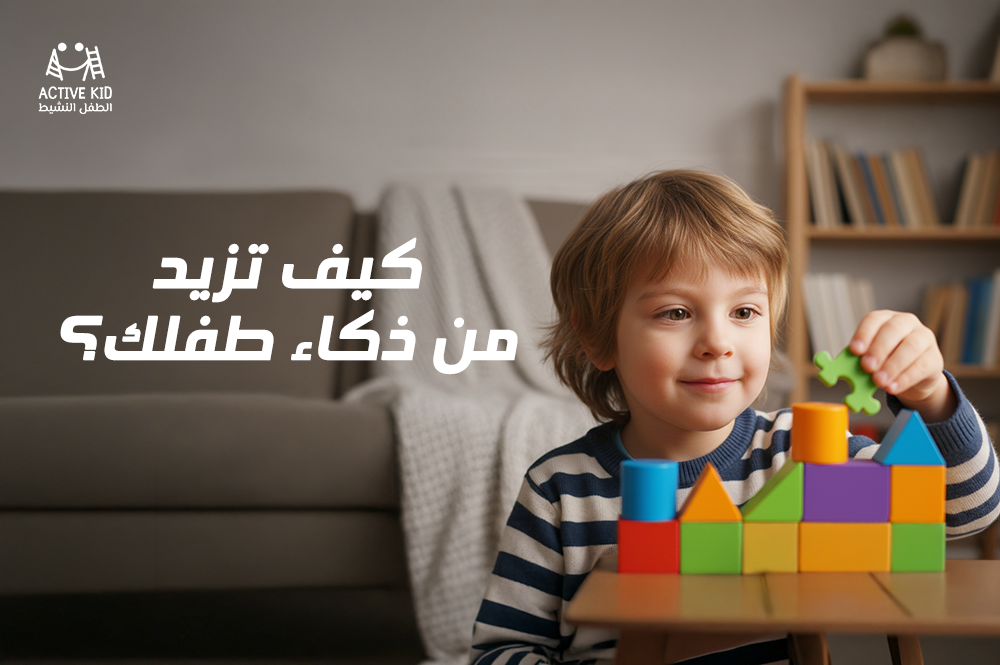
Play is not a waste of time, as some believe; rather, it is one of the most powerful tools for developing children's intelligence. Neuroscience studies indicate that play-based learning enhances creative thinking, problem-solving, and long-term memory.
Educational games that rely on thinking, classification, composition, and experimentation help the child to use his brain in multiple ways without feeling stressed or bored.
This highlights the importance of choosing well-thought-out games, such as the educational and mental games offered by the ActiveKidKSA website , which focuses on providing children’s games that help develop mental and motor skills in a fun and safe way, suitable for different age groups.
Third: Encourage your child to ask questions
A smart child is a curious child. When your child asks many questions, it's a healthy sign of their mental activity. Avoid silencing them or belittling their questions, even if they seem simple or repetitive. Try answering them in a simple way, or involve them in the search for the answer, as this process fosters critical thinking and exploration skills.
Fourth: Daily reading makes a big difference
Reading is one of the most powerful factors in raising children's linguistic and cognitive intelligence. Reading stories before bed, or setting aside daily time for picture books, contributes to:
- Expanding vocabulary
- Improving focus and attention
- Developing imagination
- Enhancing the ability to understand and analyze
Even children who have not yet learned to read benefit from hearing and discussing stories.
Fifth: Provide your child with a stimulating and safe environment.
The surrounding environment plays a crucial role in a child's intellectual development. Provide a safe space for experimentation, making mistakes, and discovering. Don't let the fear of failure hold them back. A child who feels emotionally secure is more willing to learn and take initiative.
Also, be sure to reduce excessive reliance on screens, and replace them with interactive activities such as hands-on games, construction, and drawing, which promote creative thinking and mental abilities.
Sixth: Proper nutrition is the foundation of intelligence
It's impossible to discuss developing intelligence without addressing nutrition. The brain needs essential nutrients to function efficiently, such as:
- Omega 3
- Iron
- Zinc
- Vitamins
Make sure to provide balanced meals that include vegetables, fruits, fish, and nuts, while reducing processed sugars that negatively affect concentration and attention.
Seventh: Social interaction develops emotional intelligence
Group play and interaction with other children help develop social and emotional intelligence, such as understanding emotions, cooperating, and resolving conflicts. Group games and shared activities teach children skills that are just as important as academic intelligence, and equip them to face life with confidence.
Eighth: The role of specialized educational games
Choosing games appropriate for a child's age and abilities makes a significant difference in their mental development. Games that involve thinking, solving puzzles, and simple challenges stimulate the brain to work with focus and persistence.
This is where the value of specialized platforms like ActiveKidKSA comes in , which offer children’s games designed to support mental and motor development, while taking into account the entertainment aspect that motivates the child to learn without getting bored.
Summary
Boosting a child's intelligence isn't a complicated or exhausting task; it's a daily journey that relies on awareness, patience, and smart choices. Through purposeful play, reading, positive interaction, proper nutrition, and a supportive environment, you can help your child discover their full potential and build a strong foundation for their future. Always remember that every child is intelligent in their own way, and your role is to help them shine in their own unique way, not in the way others have chosen for them.